

China Mobile’s model for experience-oriented operations
- Details
- Category: Vendors
- 642 views

Telecoms operators have spent years expanding network capacity. Yet a stronger network does not always feel like a better one to the person using it. A fan at a sold-out concert may still struggle to upload a video; a commuter can see latency spike during a video call as a train moves between cells. For customers, the quality of a connection is measured in moments like these - not in network metrics alone.
China Mobile’s experience-oriented operations initiative takes aim at that gap. Using the UE Logo 2.0 interactive terminal portal alongside the core-network analytics capability NWDAF and Huawei’s XSpeed Intelligent Golden Pipe, the operator is bringing network optimisation closer to the user and the moment when it is needed. Commercial deployments across multiple provinces in China offer a practical example of how operators can make premium network capabilities easier to discover, activate and experience.
Putting the service where the need arises
The model is designed for scenarios where network demand and user expectations meet: crowded stadiums and tourist attractions, and high-speed rail journeys and metro commutes. At a concert, people may be filming and sharing high-definition video while thousands of others are doing the same. On a train, a business traveller might be on a video call while a gamer streams or downloads content.
In both settings, a user’s experience can deteriorate even when conventional network indicators appear acceptable. Congestion can slow uploads or cause them to fail; fast handovers between cells can introduce jitter and sudden latency spikes. And if an operator’s premium optimisation service is difficult to find, customers may not know it is available until after the disruption.
UE Logo 2.0 is intended to close that last-mile gap. Building on the earlier version’s ability to display network identity and entitlements, the upgraded portal adds two-way interaction. A pull-down notification bar gives users a place to check network status and available services, including free trials and one-tap activation. A dynamic “Live Window” can surface a tailored optimisation option when conditions degrade.
The shift is from asking customers to search for a service to presenting a relevant option when they are likely to need it. In a stadium or on a journey, that can mean activating an optimisation without leaving the app or activity already in progress.
A closed loop from perception to delivery
Behind the portal, NWDAF helps connect network conditions with user and service experience. It brings together data on factors such as service performance, location and network load to identify changing demands in specific scenarios. Those insights can inform policy decisions and coordinate core and radio network resources for differentiated service delivery.
The aim is a continuous loop: detect a change in experience, decide on an appropriate response, coordinate resources, deliver the service and assess the outcome. That gives the operator a way to match network treatment more closely to the user, application and setting.
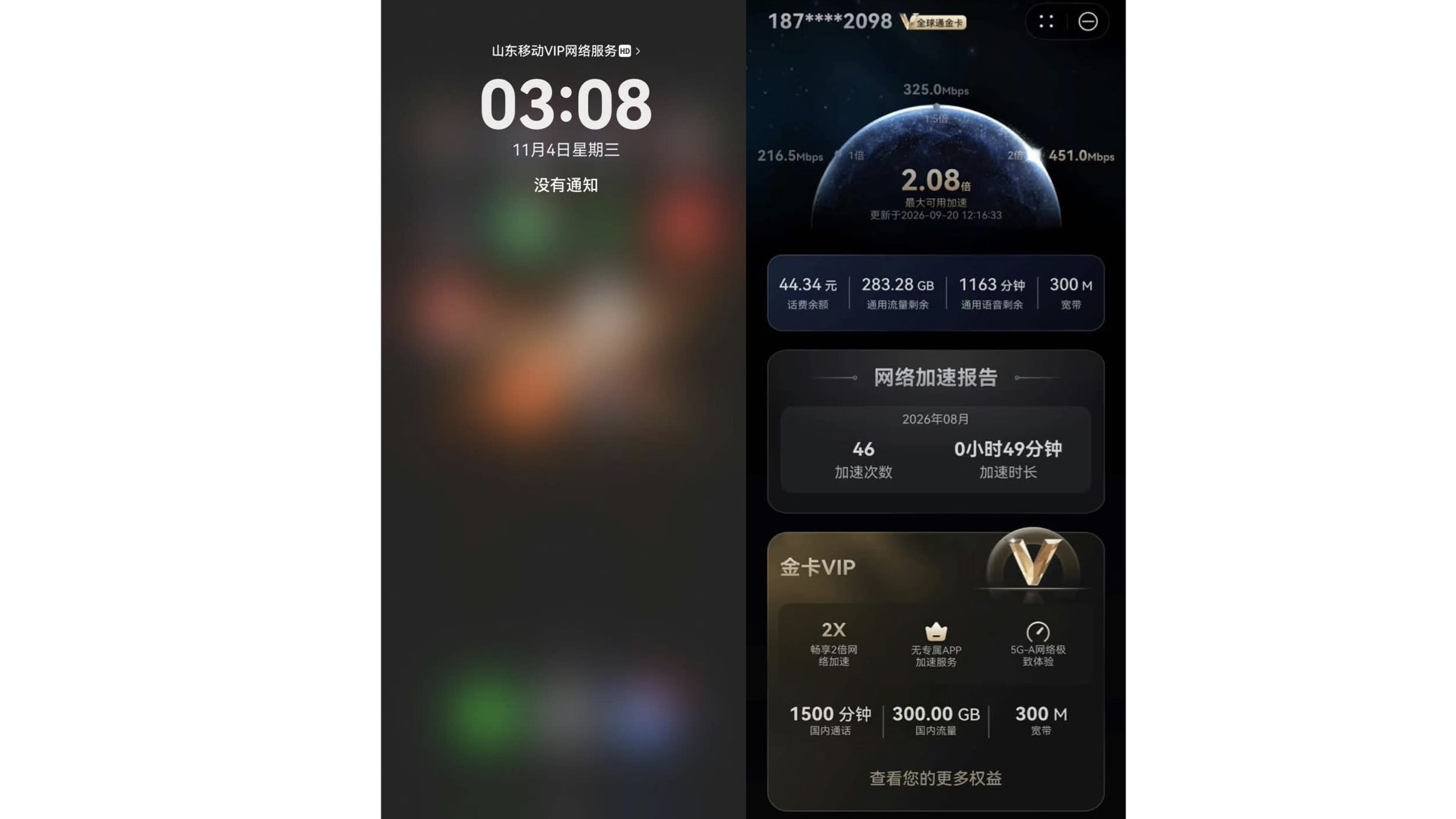
XSpeed provides the deterministic rate assurance element. Using 5G-Advanced multi-carrier coordination and joint control of time and frequency resources, it is designed to improve rate stability for users who opt into the service. The brief reports up to a twofold relative deterministic rate gain for subscribed users under the solution, while preserving baseline internet access for other customers and managing overall network capacity.
That balance matters. The proposition is not to give a small number of users a premium experience at the expense of everyone else. It is to use network resources more deliberately, with differentiated guarantees that can be activated when they add value.
From trials to commercial deployment
China Mobile’s provincial work illustrates how the approach is being tested and extended. Henan began joint innovation on UE Logo 2.0 and multi-speed optimisation in 2025. On 28 April 2026, it launched the combination commercially, with a scenario-led service model that includes trial before adoption. By October 2026, the initiative had reached 10,000 commercial users, according to the brief.
The solution has been validated at sports stadiums, cultural tourism sites and on high-speed rail routes. Henan has prepared capacity for a user base of 100,000 to support further rollout. Separately, NWDAF-based exclusive guarantee entitlements have surpassed 10 million users, extending experience improvements to a broader consumer base.
Shandong has focused on turning the approach into a repeatable operating model. It has integrated multi-speed optimisation with the UE Logo 2.0 portal, including a speed dial and an entitlement panel, and tested portal stability across geographies and device models. The province’s roadmap includes commercial trials and measurement through an online operations platform, supporting evaluation as deployments grow.
For users, the intended difference is straightforward: when a network slows, the option to improve the connection is visible and easy to activate. One stadium-goer quoted in the brief described being able to accept an acceleration prompt and share footage without leaving the current app. A commuter cited clearer status information and a prompt when network fluctuations affected video calls and gaming.
The commercial model also offers operators ways to package the capability. High-end plans can include multi-speed optimisation entitlements, while separate 1.5-times and two-times acceleration packages can be paired with monthly free trial allowances. Huawei’s brief says commercial trials have seen a 20–35% increase in conversion to premium services. The “try before buy” approach is designed to let customers experience the benefit before committing.
A broader operating model for operators
The significance extends beyond a single product or network feature. Experience-oriented operations point to a change in how operators organise consumer services: from selling connectivity primarily as a volume of data to making network quality more perceptible, interactive and relevant to the situation.
That differs from traditional network slicing and quality-of-service approaches, which have largely focused on enterprise requirements. This model targets consumer scenarios at scale, with reusable resources and controlled costs. It also translates specialist network capabilities into indicators and actions that customers can understand.
The approach is attracting interest across the industry. The brief cites initiatives by e&, Globe, KT and Turkcell, and comparable priority services from Telkomsel in Indonesia, AIS in Thailand and Zain in Saudi Arabia. China Mobile has also worked with provincial subsidiaries and partners including China Mobile Device Company, OPPO, HiSilicon and Huawei on UE Logo 2.0 and related technologies, with contributions to GSMA and 3GPP work.

Wider adoption will depend on more than network equipment. Interactive portal features require support from device makers, and compatibility remains uneven. Operators will also need to explain scenario-based services to customers used to straightforward data plans. Since spectrum allocations and carrier deployments vary, performance and rollout timelines will differ by market; each operator will need to adapt the model to local conditions.
There may also be an efficiency benefit. By dynamically reusing available spectrum, operators can seek experience gains without relying solely on new site builds, potentially reducing the energy demands associated with capacity expansion. At major public events, more targeted resource coordination can help maintain important services within finite network resources.
Making experience a network capability
As user expectations diversify, capacity growth alone cannot guarantee a better experience. China Mobile’s deployments show how an interactive service portal, network analytics and coordinated resource scheduling can work together to make optimisation visible and usable in everyday scenarios.
For Huawei’s Cloud Core Network business, the initiative demonstrates the role of the core network in linking insight to action: understanding experience in context, informing differentiated policies and helping deliver services through a convenient user touchpoint. The broader lesson for operators is that the value of network capabilities depends partly on whether customers can perceive and access them.
As networks evolve toward 6G, real-time perception, scenario awareness and on-demand optimisation are likely to become increasingly central to experience-led design. The path begins with a practical loop: network capability, clear user perception and convenient activation. China Mobile’s experience-oriented operations offer one model for building that loop at consumer scale.

More Articles you may be Interested in...








Reliance Jio Platforms IPO is India’s biggest ever


AST SpaceMobile gains S-band authorisation in Brazil



Video Executive Interviews @ MWC27 Barcelona


Botswana invests in coverage along major highway